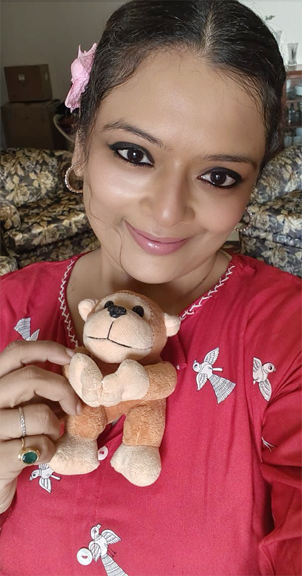
Dhruvee Haldankar on Why Viral Animal Stories Touch Our Deepest Emotions
Dhruvee Haldankar on Why Viral Animal Stories Touch Our Deepest Emotions
Mumbai: In a world dominated by fast scrolling, short attention spans, and curated perfection, certain videos manage to pause us in our tracks — a baby monkey clinging to a toy, or a penguin wandering far from its natural habitat. For actor and author Dhruvee Haldankar, these moments are not just “cute” or “viral” — they are deeply human reflections of our own emotional needs.
Dhruvee believes that such visuals bypass logic and connect directly with our emotional core. “We don’t just see animal behavior,” she explains. “We see loneliness, fear, and the search for comfort.” According to her, the human brain is wired for attachment from infancy, where survival itself depends on connection. So when we see animals seeking safety or affection, it activates the same caregiving and bonding instincts within us — creating what she calls “empathy without complication.”
Interestingly, Dhruvee points out that animals often act as a “safe projection screen” for our suppressed emotions. It is easier for people to say, “That baby monkey just wants its mother,” than to admit, “I still want to feel held, chosen, and safe.” These viral stories resonate deeply because they validate a truth many hesitate to acknowledge — that the need for attachment never truly goes away, it simply becomes less socially acceptable to express.

She also reflects on how vulnerability is perceived differently in humans versus animals. “Animals are allowed to be openly vulnerable,” she says. “A baby monkey clinging to a toy feels innocent, but an adult saying ‘I feel alone’ feels exposed.” In today’s culture, where self-sufficiency, emotional control, and productivity are often celebrated, people tend to externalize their vulnerability onto animals. “It feels pure there,” she adds, “but risky in ourselves.” On a personal note, Dhruvee shares how deeply she misses her own companions — her dog Coco and her cat Aslaan — highlighting the genuine emotional bonds humans form with animals. From a psychological lens, she emphasizes that secure attachment plays a crucial role in emotional well-being. “Love is not a childhood phase. It’s a lifelong regulatory system,” she explains. From infants to the elderly, connection remains essential for emotional stability, cognitive health, and even physical well-being. Its importance often goes unnoticed, she says, until it is absent.
In a society that glorifies independence, Dhruvee gently challenges the narrative. “Independence without connection becomes isolation,” she notes, underlining how the need for closeness is often misunderstood as weakness.
Ultimately, Dhruvee believes the reason such content goes viral is simple yet profound. “We are hungry for visible tenderness,” she says. In an increasingly digital and fast-paced world, moments of raw connection stand out “like water in a desert.” These stories are not just about animals — they are mirrors reflecting our own longing for comfort, safety, and love.