The India Story Review : A Bold Question About What We Put on Our Plates
The India Story Review : A Bold Question About What We Put on Our Plates
The India Story review
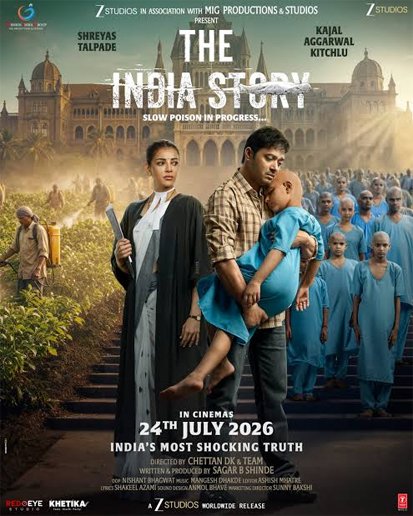
Cast: Kajal Aggarwal, Shreyas Talpade
Director: Chettan DK
Star rating: 2.5
UNN @ Varsha Parikh : The India Story, which I watched at its premiere yesterday, takes on a subject that is both deeply relevant and, in many ways, insufficiently discussed: the connection between food adulteration and the rising incidence of cancer. Rather than treating the issue as a passing social concern, the film builds its narrative around the devastating human cost of harmful chemicals entering the food chain.
At the centre of the story is Advocate Archana, who takes up a PIL on behalf of Mr. Yogesh Patish, a father who loses his daughter to cancer allegedly caused by chemicals mixed into food. What begins as a fight for justice gradually develops into a larger confrontation with the system. Archana, along with an IG officer, undertakes extensive research and works to gather enough evidence to establish her case.
The film’s strongest aspect is the way it portrays the resistance faced by anyone who challenges an established system. The government, as portrayed in the film, initially appears inclined towards the easier way out — avoiding confrontation rather than addressing the issue at its root. It is only when Archana remains firm and refuses to let the matter disappear that the larger questions begin to receive serious attention.
The conflict becomes particularly interesting because the issue initially appears to place farmers and pesticide companies on the defensive. This results in public anger, with the country seemingly divided over the issue. However, the film gradually clarifies its position. By the halfway point, the initial outrage begins to settle, and by the conclusion, the central argument becomes more apparent: the film is not against farmers. Its criticism is directed towards harmful practices involving the excessive use of chemicals on the land and their consequences for human health.
The reference to the Green Revolution adds an important historical dimension to the narrative. The film brings into discussion how the agricultural transformation that played a crucial role in strengthening India’s food production also led to practices whose long-term consequences now deserve greater scrutiny. This does not make the film an argument against progress; rather, it raises questions about what happens when the methods adopted to solve one problem eventually create another.
What makes The India Story compelling is its ability to bring an otherwise understated issue into the mainstream conversation. Cancer is usually discussed through the lens of genetics, lifestyle, or individual habits, but the film asks audiences to look at a larger and more uncomfortable possibility — the role that chemically contaminated and adulterated food may play in the disease.
The film may invite debate, particularly because it deals with a subject involving farmers, agriculture, pesticides, government policy and public health. However, that is also its strength. It does not merely offer an easy villain or a simplistic solution. Instead, it attempts to make the audience question the systems behind something as ordinary and essential as the food on our plates.
Overall, The India Story is a socially relevant film with an ambitious premise. Its greatest achievement lies in bringing the conversation about food adulteration, harmful chemicals and cancer into the public sphere. Whether one agrees with every aspect of its argument or not, the film succeeds in doing what socially conscious cinema should: it makes an issue that is often overlooked difficult to ignore.


The India Story Review : A Bold Question About What We Put on Our Plates
The India Story review
Cast: Kajal Aggarwal, Shreyas Talpade
Director: Chettan DK
Star rating: 2.5
UNN @ Varsha Parikh : The India Story, which I watched at its premiere yesterday, takes on a subject that is both deeply relevant and, in many ways, insufficiently discussed: the connection between food adulteration and the rising incidence of cancer. Rather than treating the issue as a passing social concern, the film builds its narrative around the devastating human cost of harmful chemicals entering the food chain.
At the centre of the story is Advocate Archana, who takes up a PIL on behalf of Mr. Yogesh Patish, a father who loses his daughter to cancer allegedly caused by chemicals mixed into food. What begins as a fight for justice gradually develops into a larger confrontation with the system. Archana, along with an IG officer, undertakes extensive research and works to gather enough evidence to establish her case.
The film's strongest aspect is the way it portrays the resistance faced by anyone who challenges an established system. The government, as portrayed in the film, initially appears inclined towards the easier way out — avoiding confrontation rather than addressing the issue at its root. It is only when Archana remains firm and refuses to let the matter disappear that the larger questions begin to receive serious attention.
The conflict becomes particularly interesting because the issue initially appears to place farmers and pesticide companies on the defensive. This results in public anger, with the country seemingly divided over the issue. However, the film gradually clarifies its position. By the halfway point, the initial outrage begins to settle, and by the conclusion, the central argument becomes more apparent: the film is not against farmers. Its criticism is directed towards harmful practices involving the excessive use of chemicals on the land and their consequences for human health.
The reference to the Green Revolution adds an important historical dimension to the narrative. The film brings into discussion how the agricultural transformation that played a crucial role in strengthening India's food production also led to practices whose long-term consequences now deserve greater scrutiny. This does not make the film an argument against progress; rather, it raises questions about what happens when the methods adopted to solve one problem eventually create another.
What makes The India Story compelling is its ability to bring an otherwise understated issue into the mainstream conversation. Cancer is usually discussed through the lens of genetics, lifestyle, or individual habits, but the film asks audiences to look at a larger and more uncomfortable possibility — the role that chemically contaminated and adulterated food may play in the disease.
The film may invite debate, particularly because it deals with a subject involving farmers, agriculture, pesticides, government policy and public health. However, that is also its strength. It does not merely offer an easy villain or a simplistic solution. Instead, it attempts to make the audience question the systems behind something as ordinary and essential as the food on our plates.
Overall, The India Story is a socially relevant film with an ambitious premise. Its greatest achievement lies in bringing the conversation about food adulteration, harmful chemicals and cancer into the public sphere. Whether one agrees with every aspect of its argument or not, the film succeeds in doing what socially conscious cinema should: it makes an issue that is often overlooked difficult to ignore.